Friday, September 18, 2015

MasteringAstronomy Assignment #2 Process of Science: Galileo and Kepler’s Contributions to the Model of the Solar System

Process of Science: Galileo and Kepler’s Contributions to the Model of the Solar System

Part A
Galileo Galilei was the first scientist to perform experiments in order to test his ideas. He was also the first astronomer to systematically observe the skies with a telescope. Galileo made four key observations that challenged the widely accepted philosophical beliefs on which the geocentric model was based, thus providing support for the heliocentric model. From the following list of observations, which are the key observations made by Galileo that challenged widespread philosophical beliefs about the solar systems?
Jupiter has orbiting moons. 
The Sun has sunspots and rotates on its axis. 
Venus goes through a full set of phases.
The Moon has mountains, valleys, and craters.

Part B
Johannes Kepler used decades of Tycho Brahe's observational data to formulate an accurate description of planetary motion. Kepler spent almost 30 years of his life trying to develop a simple description of planetary motion based on a heliocentric model that fit Tycho's data. What conclusion did Kepler eventually come to that revolutionized the heliocentric model of the solar system?
Kepler determined that the planetary orbits are elliptical.

Part C
Astronomers have made many observations since the days of Galileo and Kepler to confirm that the Sun really is at the center of the solar system, and that the planets revolve around the Sun in elliptical orbits. Which observation(s) could you make today that Galileo and Kepler could not have made to confirm that the heliocentric model is correct?
Transit of an extrasolar planet
Doppler shifts in stellar spectra of nearby stars
Stellar parallax in nearby stars


Ranking Task: Kepler’s Second Law of Planetary Motion

Part A
Each of the four diagrams below represents the orbit of the same comet, but each one shows the comet passing through a different segment of its orbit around the Sun. During each segment, a line drawn from the Sun to the comet sweeps out a triangular-shaped, shaded area. Assume that all the shaded regions have exactly the same area. Rank the segments of the comet’s orbit from left to right based on the length of time it takes the comet to move from Point 1 to Point 2, from longest to shortest. If you think that two (or more) of the diagrams should be ranked as equal, drag one on top of the other(s) to show this equality.


Part B
Consider again the diagrams from Part A, which are repeated here. Again, assume that all the shaded areas have exactly the same area. This time, rank the segments of the comet’s orbit from left to right based on the distance the comet travels when moving from Point 1 to Point 2, from longest to shortest. If you think that two (or more) of the diagrams should be ranked as equal, drag one on top of the other(s) to show this equality.


Part C
Consider again the diagrams from Parts A and B, which are repeated here. Again, assume that all the shaded areas have exactly the same area. This time, rank the segments of the comet’s orbit based on the speed with which the comet moves when traveling from Point 1 to Point 2, from fastest to slowest. If you think that two (or more) of the diagrams should be ranked as equal, drag one on top of the other(s) to show this equality.


Part D
Each of the four diagrams below represents the orbit of the same asteroid, but each one shows it in a different position along its orbit of the Sun. Imagine that you observed the asteroid as it traveled for one week, starting from each of the positions shown. Rank the positions based on the area that would be swept out by a line drawn between the Sun and the asteroid during the one-week period, from largest to smallest. If you think that two (or more) of the diagrams should be ranked as equal, drag one on top of the other(s) to show this equality.


Part E
Consider again the diagrams from Part D, which are repeated here. Again, imagine that you observed the asteroid as it traveled for one week, starting from each of the positions shown. This time, rank the positions from left to right based on the distance the asteroid will travel during a one-week period when passing through each location, from longest to shortest. If you think that two (or more) of the diagrams should be ranked as equal, drag one on top of the other(s) to show this equality.


Part F
Consider again the diagrams from Parts D and E, which are repeated here. Again, imagine that you observed the asteroid as it traveled for one week, starting from each of the positions shown. This time, rank the positions (A–D) from left to right based on how fast the asteroid is moving at each position, from fastest to slowest. If you think that two (or more) of the diagrams should be ranked as equal, drag one on top of the other(s) to show this equality.


Ranking Task: Kepler’s Third Law of Planetary Motion
Part A
The following diagrams all show the same star, but each shows a different planet orbiting the star. The diagrams are all scaled the same. (For example, you can think of the tick marks along the line that passes through the Sun and connects the nearest and farthest points in the orbit as representing distance in astronomical units (AU).) Rank the planets from left to right based on their average orbital distance from the star, from longest to shortest. (Distances are to scale, but planet and star sizes are not.)


Part B
The following diagrams are the same as those from Part A. This time, rank the planets from left to right based on the amount of time it takes each to complete one orbit, from longest to shortest. If you think that two (or more) of the diagrams should be ranked as equal, drag one on top of the other(s) to show this equality. (Distances are to scale, but planet and star sizes are not.)


Part C
The following diagrams are the same as those from Parts A and B. This time, rank the planets from left to right based on their average orbital speed, from fastest to slowest. If you think that two (or more) of the diagrams should be ranked as equal, drag one on top of the other(s) to show this equality. (Distances are to scale, but planet and star sizes are not.)


Part D
Each of the following diagrams shows a planet orbiting a star. Each diagram is labeled with the planet’s mass (in Earth masses) and its average orbital distance (in AU). Assume that all four stars are identical. Use Kepler's third law to rank the planets from left to right based on their orbital periods, from longest to shortest. If you think that two (or more) of the diagrams should be ranked as equal, drag one on top of the other(s) to show this equality. (Distances are to scale, but planet and star sizes are not.)


Ranking Task: Gravity and Newton’s Laws
Part A
The following five diagrams show pairs of astronomical objects that are all separated by the same distance d. Assume the asteroids are all identical and relatively small, just a few kilometers across. Considering only the two objects shown in each pair, rank the strength, from strongest to weakest, of the gravitational force acting on the asteroid on the left.


Part B
The following diagrams are the same as those from Part A. Again considering only the two objects shown in each pair, this time rank the strength, from strongest to weakest, of the gravitational force acting on the object on the right.


Part C
The following diagrams are the same as those from Part A. This time, rank the pairs from left to right based on the size of the acceleration the asteroid on the left would have due to the gravitational force exerted on it by the object on the right, from largest to smallest.


Part D
Consider Earth and the Moon. As you should now realize, the gravitational force that Earth exerts on the Moon is equal and opposite to that which the Moon exerts on Earth. Therefore, according to Newton’s second law of motion __________.
the Moon has a larger acceleration than Earth, because it has a smaller mass


Ranking Task: Newton’s Law of Gravity

Part A
Each of the following diagrams shows a spaceship somewhere along the way between Earth and the Moon (not to scale); the midpoint of the distance is marked to make it easier to see how the locations compare. Assume the spaceship has the same mass throughout the trip (that is, it is not burning any fuel). Rank the five positions of the spaceship from left to right based on the strength of the gravitational force that Earth exerts on the spaceship, from strongest to weakest.


Part B
The following diagrams are the same as those from Part A. This time, rank the five positions of the spaceship from left to right based on the strength of the gravitational force that the Moonexerts on the spaceship, from strongest to weakest.


Part C
The following diagrams show five pairs of asteroids, labeled with their relative masses (M) and distances (d) between them. For example, an asteroid with M=2 has twice the mass of one with M=1 and a distance of d=2 is twice as large as a distance of d=1. Rank each pair from left to right based on the strength of the gravitational force attracting the asteroids to each other, from strongest to weakest.


Visual Activity: Exploring a Person’s Weight in a Moving Elevator
Suppose you are in an elevator. As the elevator starts upward, its speed will increase. During this time when the elevator is moving upward with increasing speed, your weight will be __________.
greater than your normal weight at rest

Suppose you are in an elevator that is moving upward. As the elevator nears the floor at which you will get off, its speed slows down. During this time when the elevator is moving upward with decreasing speed, your weight will be __________.
less than your normal weight at rest

As you found in Part A, your weight will be greater than normal when the elevator is moving upward with increasing speed. For what other motion would your weight also be greater than your normal weight?
The elevator moves downward while slowing in speed.

If you are standing on a scale in an elevator, what exactly does the scale measure?
the force you exert on the scale

Process of Science: Explaining the Motions of the Planets

Part A
Two competing models attempt to explain the motions and changing brightness of the planets: Ptolemy's geocentric model and Copernicus' heliocentric model.
Sort the characteristics according to whether they are part of the geocentric model, the heliocentric model, or both solar system models.
Part B
Copernicus's heliocentric model and Ptolemy's geocentric model were each developed to provide a description of the solar system. Both models had advantages that made each an acceptable explanation for motions in the solar system during their time.
Sort each statement according to whether it is an advantage of the heliocentric model, the geocentric model, or both. 

Part C
The geocentric model, in all of its complexity, survived scientific scrutiny for almost 1,400 years. However, in modern astronomy, scientists seek to explain the natural and physical world we live in as simply as possible. The complexity of Ptolemy's model was an indicator that his theory was inherently flawed. Why, then, was the geocentric model the leading theory for such a long time, even though the heliocentric model more simply explained the observed motions and brightness of the planets?

Conceptual Self-Test

A major flaw in Copernicus's model was that it still had
circular orbits.

As shown in Figure 2.12 in the textbook ("Venus Phases"), Galileo's observations of Venus demonstrated that Venus must be
orbiting the Sun.

A calculation of how long it takes a planet to orbit the Sun would be most closely related to Kepler's
third law of planetary distances.

An asteroid with an orbit lying entirely inside Earth's
has an orbital semimajor axis of less than 1 AU

If Earth's orbit around the Sun were twice as large as it is now, the orbit would take
more than two times longer to traverse.

Figure 2.21 in the textbook ("Gravity"), showing the motion of a ball near Earth's surface, depicts how gravity
causes the ball to accelerate downward.

If the Sun and its mass were suddenly to disappear, Earth would
fly off into space.

During retrograde motion, planets actually stop and move backwards in space.
false

Briefly describe Kepler's three laws of planetary motion.

Answer Key: 
First law: The orbits of planets, including the Earth, are in the shape of an ellipse with the Sun at one focus.
Second law: A line connecting the Sun and a planet sweeps out equal areas in equal intervals of time; thus, a planet's orbital speed is greatest when it is closest to the Sun. 
Third law: The square of a planet's orbital period (in years) is proportional to the cube of the semimajor axis of its orbit (in astronomical units).

Galileo's discovery of four moons orbiting ________ provided new support for the ideas of Copernicus.
Jupiter

MasteringAstronomy Assignment #1 Sorting Task: Testable and Not Testable by Science

Sorting Task: Testable and Not Testable by Science
Part A
Listed following are a series of statements that each make a claim. Classify these as either testable by accepted methods of science or non-testable by accepted methods of science. Be sure to note that this question does not ask whether a statement would pass or fail a test; it only asks whether it is testable in principle.

Ranking Task: Altitude of a Star
Part A
Listed following are the latitudes of several locations on Earth. Rank these latitudes from left to right based on the maximum altitude (on the meridian) at which the celestial equator passes through the local sky, from lowest altitude (nearest the horizon) to highest altitude (farthest above the horizon).

Part B
Listed following are the latitudes of several locations on Earth. Rank these latitudes from left to right based on the maximum altitude (on the meridian) at which you would see a star with a declination of 0°, from lowest altitude (nearest the horizon) to highest altitude (farthest above the horizon).

Part C
Listed following are the declinations of five different stars. Rank these declinations from left to right based on the maximum altitude (on the meridian) each star reaches for an observer at latitude 60°N, from lowest altitude (nearest the horizon) to highest altitude (farthest above the horizon).


Shown following are five different phases of the Moon as seen by an observer in the Northern Hemisphere. Imagine that tonight the Moon is in the waxing gibbous phase (as shown at the far left (labeled “first”) in the following ranking box). Rank the pictured phases from left to right based on the order in which you would see them over the next four weeks, from first seen to last.


Visual Activity: Conditions for Eclipses
Suppose that instead of being inclined to Earth's orbit around the Sun, the Moon’s orbit was in the same plane as Earth’s orbit around the Sun. (Click “Show Moon with flat orbit” to see this situation.) In this hypothetical situation, approximately how many solar eclipses would occur each year?
12

In reality, the Moon’s orbit about Earth is tilted (by about 5°) with respect to Earth’s orbit about the Sun. As a result, the actual number of solar eclipses that occur each year is approximately _____.
2

What conditions must exist for a solar eclipse to occur?
The phase of the Moon must be new and the Moon must be passing through Earth’s orbital plane.

What conditions must exist for a lunar eclipse to occur?
The phase of the Moon must be full and the Moon must be passing through Earth’s orbital plane.

If you could change the layout of the solar system, which of the following would cause a lunar eclipse to occur at least once every month in this hypothetical situation?
Change the Moon’s orbital plane so it is in the same plane as Earth’s orbit around the Sun.


Sorting Task: Phases of the Moon
Listed following are locations and times at which different phases of the Moon are visible from Earth’s Northern Hemisphere. Match these to the appropriate moon phase.


Process of Science: Geometric Distance Measurements
Part A
Geometric reasoning can be used to measure distances both on Earth and in space. Surveyors on Earth and astronomers both use the geometric technique of triangulation to determine the distances and sizes of remote objects. In order to determine the distance using the triangulation method, a few key geometric components must be known. Once the baseline and the sightline angles are determined, then the distance can be calculated with simple geometric reasoning.
In the figure below, label the essential components used to triangulate the distance to the tree located on the opposite side of the river.
Part B
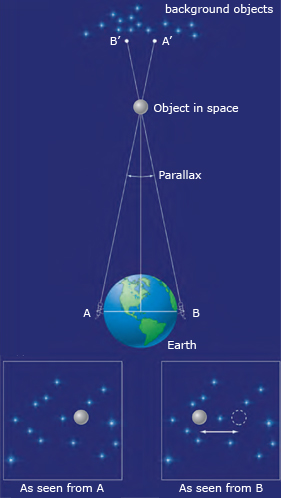
Use the figure to determine how the measured parallax changes in each of the following situations:

Match the words in the left column to the appropriate blanks in the sentences on the right. Make certain each sentence is complete before submitting your answer.


Part C
Consider the Moon and Sun. Their angular diameters are both equal to about .5 degree. If the Sun is roughly 400 times more distant than the Moon, how much bigger is the Sun’s diameter than the Moon’s?
about 400 times bigger

Sorting Task: Solstices and Equinoxes
Part A
Listed following are observable characteristics of equinoxes and solstices in the continental United States (which means temperate latitudes in the Northern Hemisphere). Match each characteristic to the corresponding equinox or solstice.

Ranking Task: Sidereal and Synodic Periods 
Part A
Each item following represents an amount of time. Recall from your reading that “sidereal” refers to events that are timed with respect to the distant stars, and “synodic” refers to special alignments of astronomical bodies, such as the Earth, Moon, and Sun. Rank the items from left to right in order of the amount of time they represent, from shortest time to longest time. If two items represent equal amounts of time, show this equality by dragging one on top of the other.


Vocabulary in Context: Describing Eclipses of the Sun and Moon
Part A
Match the words in the left-hand column to the appropriate blank in the sentences in the right-hand column. Use each word only once.


---------------------------------------------------
A long, thin cloud that stretched from directly overhead to the western horizon would have an angular size of
When a thin crescent of the Moon is visible just before sunrise, the Moon is in its
waning phase

If the Moon's orbit were a little larger, solar eclipses would be
more likely to be annular

In Figure 1.28 in the textbook ("Triangulation"), using a longer baseline would result in
a smaller angle at point B

What would the measured angle in Discovery 0-1 have been if Earth's circumference were 100000 km instead of 40000 km? (Express your answer using two significant figures.)
Angle = 2.8 degrees

What angle would Eratosthenes have measured had Earth been flat?
0 degrees

What is precession, and what causes it?
Answer Key: Discovered by the Greek astronomer Hipparchus, precession is a slow shift in the orientation of the Earth's axis of spin. Although Earth's axis maintains an axis tilt of 23.5 degrees compared to the axis of the Sun, the axis moves in a circle over the course of 26 000 years. This causes the location of the celestial poles to shift, along with the entire sky. It is caused by the gravitational influence of the Moon and Sun.

Like latitude on Earth, ________ in the sky is measured in degrees north and south of the equator.
declination

The time interval of 365.242 days is defined as the ________.
tropical year

The apparent annual path the Sun takes through the sky is called the ________.
ecliptic

One of the requirements of the Scientific Method is that an experiment must be ________.
repeatable

The star Wolf 1061 has a parallax of 2.34 arcseconds, while the star Ross 652 has a parallax of 1.70 arcseconds. What can you correctly conclude?
Wolf 1061 is closer to Earth than Ross 652.

The synodic month is
29.5 days.

A solar eclipse can only happen during a:
new moon.

The fact that the Earth has moved along its orbit in the time it took to rotate once is the reason for
the difference between solar and sidereal time.

In general, what is true of the alpha star in a constellation?
It is the brightest star in the constellation.

The south celestial pole is located at a declination of -90 degrees.
True

MasteringAstronomy Assignment #0 Characteristics of Continuous, Emission, and Absorption Spectra

Characteristics of Continuous, Emission, and Absorption Spectra

Part A
There are three general types of spectra: continuous, emission, and absorption. Each is characterized by a different distribution of the wavelengths (i.e., colors) of radiation. Sort the images of the three types of spectra into the appropriate bins.


Part B
The universe is filled with objects of extreme temperatures and densities, both high and low. The differences among the three types of spectra result from the various physical conditions in which the light is emitted, or through which it travels, before it is observed on Earth. The following three diagrams illustrate the use of a simple spectroscope in a laboratory. Match each diagram to the appropriate spectra. Note that a light bulb can be thought of as a hot, dense source of radiation.


Part C
No astronomical object that produces a continuous visible spectrum of light has ever been observed. However, there are many astronomical objects that produce emission or absorption spectra. Read the following descriptions of astronomical objects, and then sort the labeled images into the appropriate bins according to the type of spectrum each object produces.
  • Emission nebula: a cloud of hot, interstellar gas glowing as a result of one or more nearby young stars that ionize the gas.
  • Planetary nebula: a glowing cloud of hot, low-density gas that is ejected from a red-giant star.
  • Sun: a glowing ball of extremely dense gas powered by nuclear fusion in its core, but surrounded by a low-density, cooler atmosphere.
  • Atmosphere on Titan: a layer of cool, low-density gas confined close to the surface of Titan, one of Saturn's moons.


Components and Structure of the Atom

Part A
The atom consists of three types of subatomic particles: protons, neutrons, and electrons. The electron is by far the lightest of the three, while the much heavier proton and neutron have masses very similar to each other. Two of the types of particles carry an electrical charge, while the third is neutral. Label the subatomic particles and appropriate charges by their relative locations.


Part B
Of the three types of subatomic particles, only neutrons do not carry charge. Protons carry a positive charge, and electrons carry a negative charge. Protons and neutrons are bound in the nucleus, while electrons orbit the nucleus. When the number of each type of subatomic particle in an atom changes, the characteristics defining the atom also change. Match the appropriate phrases with the type of subatomic particle that completes the defining characteristic.


Part C
In the classical view of the atom, Bohr pictured electrons orbiting the positively charged nucleus similar to how the planets orbit the Sun. While this picture was not entirely correct, it provides a good framework in which to make calculations about the energies of electrons. Different from the predictions of Newtonian mechanics, which allows any energy to be possible, Bohr described the electron orbits (now called orbitals) as having specific energies. Rank the following electron energy states according to their electron energies.


Part D
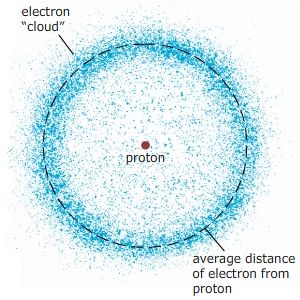
The Bohr model accounted for most of the general characteristics of the atom. However, the modern model based on quantum mechanics explains that, although the energy of each orbital is fixed, the orbital radius is actually an average distance. The result is a "cloud" where the electron would most probably be located.

When electrons are excited to different energy levels, the average radii from the nucleus also changes. Rank the following electron energy states according to the average distance of the electron from the nucleus. Rank from largest to smallest distances.


Electromagnetic Radiation

Part A
Light is a wave, and, like all waves, it is characterized by specific physical characteristics. Identify the key physical characteristics of a wave in the figures below. Figure A shows a wave as a function of time, and Figure B shows a wave as a function of space.


Part B
If you throw a rock into a pond, it creates a wave in the water. What is responsible for creating an electromagnetic wave?
A vibrating charged particle

Part C
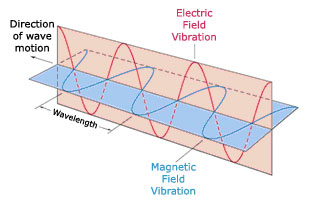
The law of physics state that a magnetic field must accompany a changing electric field, and a change in one must create a change in the other. Together, electric and magnetic fields make up electromagnetic waves, which carry energy and information from one part of the universe to another. Electromagnetic waves share many properties with ordinary waves, but they also have a number of unique characteristics. Using the figure below and your knowledge from Parts A and B, complete the following statements about the specific properties of electromagnetic radiation.


Ranking Task: Reflecting Telescopes and Light Collection

Part A
Listed following are the names and mirror diameters for six of the world’s greatest reflecting telescopes used to gather visible light. Rank the telescopes from left to right based on their light-collecting area from largest to smallest. For telescopes with more than one mirror, rank based on the combined light-collecting area of the mirrors.


Part B
Shown following are the primary mirror arrangements and total light-collecting area of five different telescopes. Each mirror uses a different segmented arrangement, but assume that they are all equivalent in quality and in their ability to focus light. Also assume that the telescopes use identical detectors and have the same observing conditions. Rank the telescopes from left to right based on their ability to detect very dim objects, from greatest to least. To rank two (or more) telescopes as equal, drag one on top of the other(s).


Part C
Shown following are the primary mirror arrangements and total light-collecting area of five different telescopes. Notice that although the arrangements look similar to those in Part B, the light-collecting areas are not the same. Also listed is an amount of time (exposure time) that each telescope will be pointed at the same distant galaxy. Again assume that the quality of these mirrors, the detectors, and the observing conditions are identical. Rank the telescopes from left to right based on the brightness of the image each telescope will take of the galaxy in the time indicated, from brightest to dimmest. To rank two (or more) telescopes as equal, drag one on top of the other(s).


Sorting Task: Characteristics of Reflecting and Refracting Telescopes

Part A
Listed following are distinguishing characteristics and examples of reflecting and refracting telescopes. Match these to the appropriate category.


Visual Activity: Atmospheric Absorption of Light at Different Wavelengths
Part A
Which of the following forms of light can be observed with telescopes at sea level?
visible light
radio waves

Part B
If our eyes were sensitive only to X rays, the world would appear __________.
dark because X-ray light does not reach Earth’s surface

Part C
If you had only one telescope and wanted to take both visible-light and ultraviolet pictures of stars, where should you locate your telescope?
in space


Sorting Task: Interaction of Light and Matter

Part A
Listed following are various physical situations that describe how light interacts with matter. Match these to the appropriate category.


Sorting Task: Temperature Scales

Part A
Each of the following items states a temperature, but does not tell you whether the temperature is measured on the Fahrenheit, Celsius, or Kelvin scale. Match the items to the appropriate temperature scale.