Friday, September 18, 2015

MasteringAstronomy Assignment #6 The Surface of Venus

The Surface of Venus
Part A
Compare the surface characteristics of Venus with those of Earth.

Part B 
Venus and Earth's Moon are quite different. Venus is much larger, more massive, and has an atmosphere. However, Venus and the Moon share some similar surface features. Sort the following surface characteristics as describing Venus, the Moon, or both.

Part C
Many of Venus’s volcanic surface features are similar to those on Earth and the Moon. Compare and contrast the following features on Venus with similar features on Earth and the Moon.


Characteristics of Venus's Atmosphere
Part A
A convenient way to analyze a planet's atmosphere is to observe how its structure, pressure, and temperature vary with altitude. Compare the atmospheric cross-sectional diagrams for Venus and Earth and complete the statements as to whether the various atmospheric properties of Venus are "greater than Earth's" or "less than Earth's."


Part B 
The following characteristics describe the composition, structure, and features found in the atmospheres of Earth and/or Venus. Sort the various statements as describing Venus, Earth, or both.


Part C
The drastic contrast between the atmospheres of Venus and Earth is evident in their atmospheric compositions. For each planet, place the four atmospheric gases in order of their abundances.

Visual Activity: Exploring the Surface Features of Mars 
Part A
Assuming that features you see on Mars are similar to features found on Earth, what would a casual inspection of the interactive photo of Mars lead you to suspect about water on Mars?
Surface water only exists as frozen ice.

Part B 
Which of the following Mars surface features provides dramatic evidence that volcanism has played a role in shaping the surface of Mars?
Olympus Mons

Part C
When you zoom in on the section labeled “Southern Highlands,” which geologic processes are most clearly evident?
impact cratering and erosion

Ranking Task: Atmospheric Pressure
Part A
The following images show the four terrestrial planets in our solar system. Rank these planets from left to right based on the atmospheric pressure at the surface, from highest to lowest. (Not to scale.)


Part B
The following images show the four terrestrial planets in our solar system. Rank these planets from left to right based on the total amount of gas in their atmospheres, from most to least. (Not to scale.)

Ranking Task: Understanding the Greenhouse Effect in Planet Atmospheres
Part A
The following images show four types (wavelengths) of light. Rank these from left to right based on the amount of each that is emitted (as thermal radiation) by Earth’s surface, from greatest to least. If you think that two (or more) types should be ranked as equal, drag one on top of the other(s) to show this equality.


Part B 
In Part A, you found that Earth emits only infrared light. This infrared light can be absorbed by greenhouse gases, such as carbon dioxide and water vapor, in the atmosphere. In fact, all the terrestrial planets emit infrared light from their surfaces. The following images show the four terrestrial planets in our solar system. Rank these planets from left to right based on the total amount of infrared-absorbing greenhouse gases in their atmospheres, from greatest to least.


Part C
The following images show the four terrestrial planets in our solar system. Rank the planets from left to right based on the strength of the greenhouse effect occurring at their surfaces, from strongest to weakest.


Part D
The following images show the four terrestrial planets in our solar system. Rank the planets from left to right based on the amount by which the greenhouse effect increases their surface temperatures, compared to what their temperatures would be without the greenhouse effect, from largest to smallest increase.

Sorting Task: Terrestrial Planetary Atmospheres
Part A
Listed following are characteristics of the atmospheres of Venus, Earth, and Mars. Match each atmospheric characteristic to the appropriate planet.


Ranking Task: Tectonic Activity of the Terrestrial Planets
Part A
Shown below are the four terrestrial planets of our solar system. Assume that all the planets started out equally hot inside. Rank the planets based on their expected cooling rates, from fastest cooling to slowest cooling.

Part B
Shown following are three terrestrial planets of our solar system. Rank the planets based on the amount of time the surface of the planet has had a moderate to high level of volcanic/tectonic activity, from longest to shortest.


Sorting Task: Geological Processes
Part A
Listed below are geographic features of the terrestrial worlds. In each case, identify the geological process: impact cratering, volcanism, erosion, or tectonics (where tectonics is any large-scale processes affecting the structure of the planetary crust), most responsible for the feature described. Match the geographic feature to the appropriate geologic process.

-----------------------------

Although Mars appears quite bright, it is still considerably fainter than Venus due to a combination of three factors. Which of the following is NOT one of the three factors?
The red color of Mars's surface causes it to appear less bright.

MasteringAstronomy Assignment #5 The Moon's Surface Features Show a Dynamic History

The Moon's Surface Features Show a Dynamic History
Part A
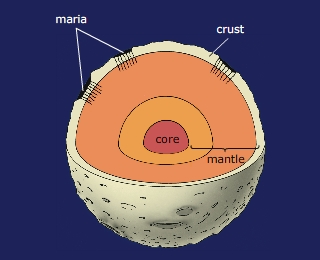
The Moon has two distinct types of terrain: the maria and the highlands. On the image of the Moon below, label the specified regions as either maria or highlands.

Part B
The Moon's maria and highlands can be described by the characteristics present in each. Sort the following characteristics by whether they describe the maria or the highlands.


Part C
The relative number of craters found in the maria and the highlands greatly differs. In addition, we have inferred that the maria formed from molten lava welling up from the Moon's mantle. Use this information to rank the following images of lunar regions in order of relative age, from oldest to youngest.


Mercury's Spin-Orbit Resonance
Part A
Compare the magnitude of the Sun's gravitational force on Mercury at locations A, B, and C. (Figure not to scale.)

Part B
In the mid-nineteenth century, astronomers thought that Mercury should be tidally locked to the Sun, meaning it would rotate once for every revolution around the Sun. This scenario would be similar to how the Moon is tidally locked in its orbit around Earth. However in the 1960s, astronomers determined that Mercury is not tidally locked to the Sun. The large eccentricity (exaggerated in the figure) of Mercury's orbit causes large variations in its orbital speed, which prevents tidal locking. Rank the following orbital locations from the fastest orbital speed to the slowest.

Part C
An orbiting body with a tidal bulge, such as Mercury, will try to settle into a synchronous orbit with its partner (in this case, the Sun). However, due to the large eccentricity of Mercury's orbit, the orbital speed at perihelion is very different from the speed at aphelion, making it impossible for Mercury and the Sun to lock in a synchronous orbit. Even though Mercury's orbital speed changes as it travels around the Sun. Mercury's rotation rate and orbital period will synchronize into a simple spin-orbit resonance. Will it synchronize at perihelion or aphelion? (Eccentricity exaggerated for illustration.)
perihelion

The Surface of Mercury
Part A
Though Mercury is a planet orbiting the Sun and the Moon is a natural satellite orbiting Earth, Mercury and the Moon have numerous similarities in appearance. Neither body maintains an atmosphere and both have rocky surfaces that show the marks of their exposed surfaces. Scientists have identified and defined numerous types of surface features. Sort the surface feature terms according to whether they describe features of Mercury, the Moon, or both.

Mercury:  scarp & intercrater plains
  Moon:    mare
  Both:     crater

Part B
In the image, a scarp known as the Discovery Scarp is shown cutting across several craters. Unlike Earth, Mercury has no plate tectonics or fault lines, so astronomers theorize that the scarp was produced by a process that involved a cooling and contracting of Mercury's surface. Rank the surface features by their relative ages from oldest to youngest.

Process of Science: Formation of the Moon

Part A - Theories of moon formation
Before you can determine which theory best fits the data, you need to define the three theories.

Part B
A theory is a framework of ideas and assumptions used to explain some set of observations and to make predictions about the real world. Each of the three theories for the formation of the Moon lead to different predictions about evidence that we should find. Which of the following predictions should be true if each theory is correct?

Part C
To be effective, a scientific theory must be continually tested. If observations and experiments favor it, a theory can be further developed and refined. If they do not, the theory must be reformulated or rejected. Comparing what you know about the predictions of each Moon formation theory, determine which of the following observations and experiments have been verified.
Earth has a large iron core; the Moon does not.
The mantles of Earth and the Moon have similar compositions.
Computer simulations predict that a collision between Earth and a Mars-sized object would produce a Moon-sized satellite with a stable orbit.

Part D
Based on the evidence for the impact theory, what was the most probable order of events for the collision that led to the formation of the Moon?

MasteringAstronomy Assignment #4 Visual Activity: Exploring the Cause of the Greenhouse Effect

Visual Activity: Exploring the Cause of the Greenhouse Effect

On a cloudless day, what happens to most of the visible light headed toward Earth?
It reaches Earth’s surface, where some is reflected and some is absorbed.

On a day with complete cloud cover, what happens to the visible light headed toward Earth?
The clouds reflect much of it back to space, though some still reaches the surface

What happens to the energy that the ground absorbs in the form of visible sunlight?
It is returned upward in the form of infrared light.

The greenhouse effect raises Earth’s surface temperature (from what it would be otherwise) because the infrared light radiated by Earth’s surface __________.
is temporarily absorbed by greenhouse gases and then reemitted in random directions


Internal Structure of Earth
Part A
We currently believe that Earth’s structure is made up of six main regions. Three of these regions can be directly observed and three cannot. Label the six major regions of Earth in the following image.


Part B
Although scientists cannot directly observe Earth’s mantle or core, they can learn about these regions indirectly by observing the behavior of seismic waves from earthquakes. Seismic waves come in two basic forms (see figure). Pressure (P) waves move material back-and-forth in the direction of the waves' motion. Compressing and expanding a slinky will produce this sort of oscillation. Shear (S) waves, on the other hand, move material side-to-side in directions perpendicular to the waves' motion. The oscillations of a jump rope, a guitar string, and the ocean surface are all examples of shear waves.


Part C
By sensing the different types of seismic waves from earthquakes, it is possible to create a model of Earth's interior that satisfies scientific observations. Scientists station seismographs all around Earth to record earthquakes. By analyzing the data, scientists can determine which stations detect which kinds of waves from a particular earthquake. In the following figure, an earthquake on one side of Earth has produced longitudinal pressure waves (P-waves) and perpendicular shear waves (S-waves). The P-waves can travel through liquid, but the S-waves cannot. Given the interior structure depicted in the figure, label the types of waves that would be detected by stations at the four different positions.


Part D
To understand how Earth’s interior structure was formed, we need to go back in time to its formation during the birth of the solar system. Astronomers believe that when Earth and the other terrestrial planets formed, a process called differentiation occurred. Rank the steps of the differentiation process in order from the initial stage to the final stage.


Gravitational Interactions between Earth and the Moon

Part A
The Moon and Earth interact through their mutual gravitational forces. The Moon's rotation rate and the ocean tides on Earth are consequences of the gravitational tidal forces exerted by each body on the other. Considering the Moon, rank the gravitational tidal force exerted on it by Earth for three different lunar locations.


Part B
Due to gravitational tidal forces from Earth, the Moon has a deformation of its shape known as a tidal bulge. Likewise, Earth has a tidal bulge owing to the Moon's gravity. The image choices show both tidal bulges, where the arrows denote the direction of gravitational attraction. Which image choice shows the correct relative alignments for the tidal bulges of both Earth and the Moon?


Part C
Besides creating a tidal bulge on the Moon, Earth's gravitational tidal force also affects the Moon's rotation by exerting a force that keeps one side of the Moon's tidal bulge facing Earth as it orbits. This particular phenomenon is called tidal locking, where the Moon's rotation and orbital periods are synchronized. A similar force is exerted by the Moon on Earth's rotation, but to a much smaller extent. Comparing the rotation and orbital period of the Moon with those of Earth, rank the periods from longest to shortest.


Earth's Magnetosphere

Part A
According to the current understanding of Earth's magnetic field and how magnetic fields are generated, which two components in Earth's internal structure are required in order to generate a magnetic field?
Rapidly rotating core
Conducting liquid core

Part B
Earth's magnetosphere acts as a protective shield against the dangerous, high-energy solar wind. The magnetosphere can be visualized as a large sheath surrounding Earth and extending out into space. Two important structures, known as the Van Allen belts, compose the inner regions of the magnetosphere and directly affect the auroral events seen on Earth. Label the appropriate regions of the inner magnetosphere.


Part C
An auroral event occurs due to the interaction between the solar wind, Earth's magnetosphere, and Earth's atmosphere. The following steps describe the process of events leading to the formation of an aurora. Rank the steps in sequence from first to last, in order of how they must occur.


Vocabulary in Context: Plate Tectonics


Conceptual Self-Test
At Earth's geographic North Pole, a magnetic compass needle would point (approximately)
toward Kansas City

If Earth had no Moon, then tides would
occur with the same frequency, but would not be as strong.

Which of the following statements is true?
Because of the tides, the Moon is spiraling away from Earth.

MasteringAstronomy Assignment #3 Ranking Task: Formation of the Solar System


Ranking Task: Formation of the Solar System
Provided following are stages that occurred during the formation of our solar system. Rank these stages from left to right based on when they occurred, from first to last.

Ranking Task: Orbital Distance, Mass, and Radius of Planets
Part A
The following images show six objects in our solar system. Rank the objects from left to right based on their average distance from the Sun, from farthest to closest. (Not to scale.)


Part B
The following images show six objects in our solar system. Rank these objects from left to right based on their mass, from highest to lowest. (Not to scale.)


Part C
The images below show six objects in our solar system. Rank these objects by size (average equatorial radius), from largest to smallest. (Not to scale.)


Visual Activity: Comparative Planetology

Assuming that other planetary systems form in the same way as our solar system formed, where would you expect to find terrestrial planets?
Terrestrial planets will likely be located nearer the planetary system’s star than any jovian planets.

Compared to terrestrial planets, jovian planets are __________.
more massive and lower in average density

Which planet is approximately halfway between Pluto’s orbit and the Sun?
Uranus, the seventh planet from the Sun

The dwarf planet Eris was discovered in 2005, orbiting the Sun at an average distance about twice that of Pluto. In which of the following ways do Pluto and Eris differ from the terrestrial and jovian planets in our solar system?
Both Pluto and Eris are smaller than any of the terrestrial planets.
Both Pluto and Eris travel in more elliptical orbits than any of the terrestrial or jovian planets.
Both Pluto and Eris are less massive than any of the terrestrial or jovian planets.


Ranking Task: Matter in the Solar System

Part A
The materials that made up the solar nebula can be categorized into the four general types as follows. Rank these materials from left to right based on their abundance in the solar nebula, from highest to lowest.


Part B
The materials that made up the solar nebula can be categorized into these four general types. Rank these materials from left to right based on the temperature at which each would condense into a solid, from highest to lowest. Note: For a substance that does not condense at all, rank it as very low temperature.


Part C
As you’ve learned from Part B, hydrogen and helium gas never condense under conditions found in the solar nebula. The remaining three categories of material in the solar nebula are shown again here. Rank these materials from left to right based on the distance from the Sun at which they could condense into a solid in the solar nebula, from farthest to closest.

Visual Activity: Condensed Materials in Different Regions of the Disk of the Forming Solar System
What substances were found within the inner 0.3 AU of the solar system before planets began to form?
Rocks, metals, hydrogen compounds, hydrogen, and helium, all in gaseous form

What substances existed as solid flakes within the inner 0.3 AU of the solar system before planets began to form?
none

Where would you expect terrestrial planets to form in the solar nebula?
anywhere between 0.3 AU and the frost line

The jovian planets are thought to have formed as gravity drew hydrogen and helium gas around planetesimals made of __________.
rocks, metals, and ices


Sorting Task: Formation of Terrestrial and Jovian Planets
Listed following are statements that, based on our current theory of solar system formation, apply either to the formation of terrestrial planets or of jovian planets, but not both. Match these to the appropriate category.

Sorting Task: Characteristics of Terrestrial and Jovian Planets
Listed following are characteristics that can identify a planet as either terrestrial or jovian. Match these to the appropriate category.


Ranking Task: Understanding Comet Tails

The following figures show four positions (1-4) of a comet during its orbit of the Sun. Also shown is the orbit of the Earth around the Sun. Rank the positions of the comet from left to right based on the size of its tail, from shortest to longest. (Not to scale; tails not shown.)