Wednesday, July 3, 2019

Wages of $12,000 are earned by workers but not paid as of December 31, 2017.

1.
  1. Wages of $12,000 are earned by workers but not paid as of December 31, 2017.
  2. Depreciation on the company's equipment for 2017 is $11,680.
  3. The Office Supplies account had a $350 debit balance on December 31, 2016. During 2017, $4,676 of office supplies are purchased. A physical count of supplies at December 31, 2017, shows $518 of supplies available.
  4. The Prepaid Insurance account had a $5,000 balance on December 31, 2016. An analysis of insurance policies shows that $2,200 of unexpired insurance benefits remain at December 31, 2017.
  5. The company has earned (but not recorded) $850 of interest from investments in CDs for the year ended December 31, 2017. The interest revenue will be received on January 10, 2018.
  6. The company has a bank loan and has incurred (but not recorded) interest expense of $4,500 for the year ended December 31, 2017. The company must pay the interest on January 2, 2018.
For each of the above separate cases, prepare adjusting entries required of financial statements for the year ended (date of) December 31, 2017. 
NoTransactionGeneral JournalDebitCredit
1a.12,000selected answer correctnot attempted
not attempted12,000selected answer correct
2b.11,680selected answer correctnot attempted
not attempted11,680selected answer correct
3c.4,508selected answer correctnot attempted
not attempted4,508selected answer correct
4d.2,800selected answer correctnot attempted
not attempted2,800selected answer correct
5e.850selected answer correctnot attempted
not attempted850selected answer correct
6f.4,500selected answer correctnot attempted
not attempted4,500selected answer correct

c=350+4676-518
d=5000-2200


Tuesday, July 2, 2019

On May 15, DeShawn Tyler opens a landscaping company called Elegant Lawns by investing $88,000 in cash along with equipment having a $48,000 value

1.
Classify each of the following accounts as an asset (A), liability (L), or equity (EQ) account.
-----------------------------------------------------------------------------------

2.
Identify the normal balance (debit or credit) for each of the following accounts.
-----------------------------------------------------------------------------------

3.
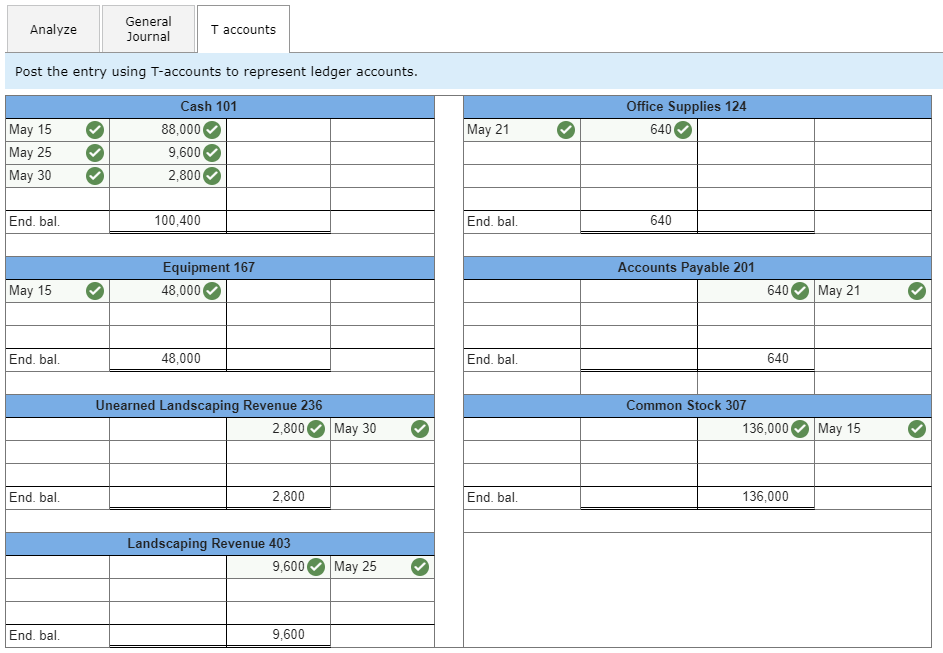
For each transaction, (1) analyze the transaction using the accounting equation, (2) record the transaction in journal entry form, and (3) post the entry using T-accounts to represent ledger accounts. Use the following (partial) chart of accounts—account numbers in parentheses: Cash (101); Accounts Receivable (106); Office Supplies (124); Trucks (153); Equipment (167); Accounts Payable (201); Unearned Landscaping Revenue (236); Common Stock (307); Dividends (319); Landscaping Revenue (403); Wages Expense (601), and Landscaping Expense (696).
  1. On May 15, DeShawn Tyler opens a landscaping company called Elegant Lawns by investing $88,000 in cash along with equipment having a $48,000 value in exchange for common stock.
  2. On May 21, Elegant Lawns purchases office supplies on credit for $640.
  3. On May 25, Elegant Lawns receives $9,600 cash for performing landscaping services.
  4. On May 30, Elegant Lawns receives $2,800 cash in advance of providing landscaping services to a customer.

-----------------------------------------------------------------------------------

4.
Determine the ending balance of each of the following T-accounts.

-----------------------------------------------------------------------------------

5.
Indicate the financial statement on which each of the following items appears. Use I for income statement, E for statement of retained earnings, and B for balance sheet.

Monday, July 1, 2019

Total assets of Charter Company equal $770,000 and its equity is $455,000. What is the amount of its liabilities?

1.
a. Total assets of Charter Company equal $770,000 and its equity is $455,000. What is the amount of its liabilities?
b. Total assets of Martin Marine equal $570,000 and its liabilities and equity amounts are equal to each other. What is the amount of its liabilities? What is the amount of its equity?

Assets=Liabilities+Equity
a.$770,000=315,000selected answer correct+$455,000
b.$570,000=285,000selected answer correct+285,000selected answer correct
-----------------------------------------------------------------------------------

2.
1. Use the accounting equation to compute the missing financial statement amounts.

CompanyAssets=Liabilities+Equity
1$86,000=40,500selected answer correct+$45,500
2111,500selected answer correct=$30,500+$81,000
3$107,000=$31,000+76,000selected answer correct
2. Use the expanded accounting equation to compute the missing financial statement amounts.
CompanyAssets=Liabilities+Common StockDividends+RevenuesExpenses
1$62,000=$21,500+$31,000$0+23,000selected answer correct$13,500
2$100,900=$37,500+$55,0003,100selected answer correct+$35,000$23,500

-----------------------------------------------------------------------------------

3.

Wednesday, February 8, 2017

Consider the economy of Cocoland, where citizens consume only coconuts.Assume that cocnuts are priced at

1. Principles of tax equity
The mayor of Vancouver wants to upgrade the public transportation system. In order to fund the improvements, the mayor proposes charging an extra $1 for each ride taken.

2. Computing and interpreting average tax rates
In a hypothetical economy... The following table shows the annual taxable income and tax liability for these three single individuals...

3. Understanding marginal and average tax rates
Consider the economy of Cocoland, where citizens consume only coconuts. Assume that coconuts are priced at $1 each. The government has devised the following tax plans:

4. Taxes paid for a given income level
Akshay is single and lives in Thunder Bay. Akshay earned $60,000 in 2013. The following table shows the federal tax rate for individuals in 2013.
Fill in the following table with Akshay’s marginal tax rate, total amount of taxes owed, and average tax rate for 2013.


Wednesday, February 1, 2017

Assume that demand for a commodity is represented by the equation P = 10 – 0.2 Q d, and supply by the equation P = 2 + 0.2 Qs

I might be wrong...
Assume that demand for a commodity is represented by the equation P = 10 – 0.2 Q d, and supply by the equation P = 2 + 0.2 Qs where Qd and Q s are quantity demanded and quantity supplied, respectively, and P is the Price. Use the equilibrium condition Qs = Qd ,
1: Solve the equations to determine equilibrium price.

2: Now determine equilibrium quantity.


3: Graph the two equations to substantiate your answers and label these two graphs as D1 and S1.


4: Furthermore; assume the demand for this product increases because of a change in income.
A. graph the new demand curve and label as D 2.


B. What will be the new equilibrium price and quantity compare to the initial one.
The demand shifts to the right And both price and quantity will increase.

C. Is this product normal good or inferior good?
It is a normal good with positive income effect.